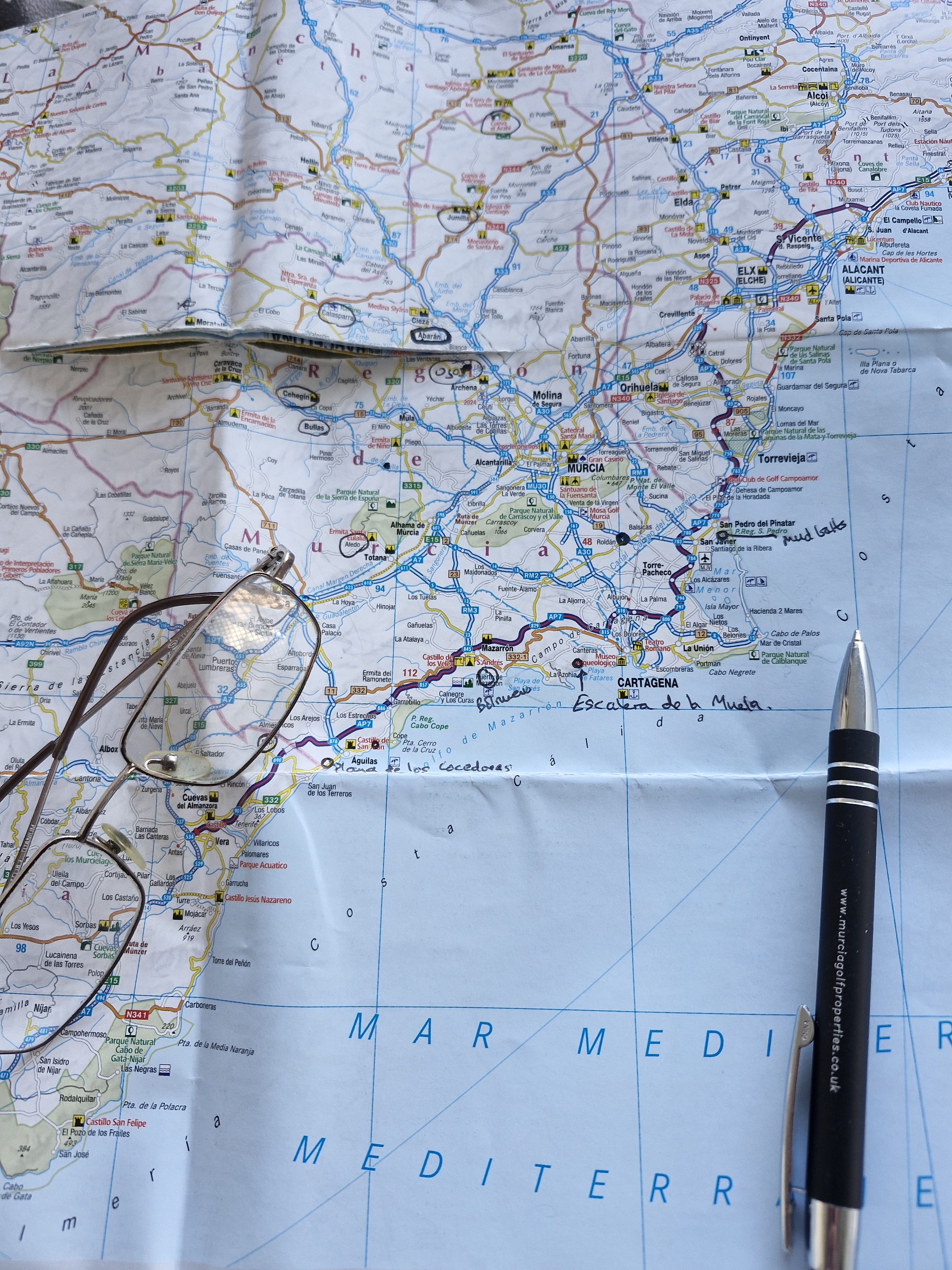

When we began our explorations of Murcia, we did something almost unheard of in the digital age – we bought a map. Yes, really. A paper, foldy thing with creases and everything, proving once and for all that we haven’t lied about our advancing years. To balance the universe, Sonja found a Facebook page celebrating all things Murcia – proof that we are, in fact, still in touch with “modern stuff.” Armed with both analogue and digital know-how, we set about marking the Facebook page’s most enticing recommendations on our newly acquired cartographic relic and drew up a grand itinerary.
Three places particularly caught our attention:
- Ojós, a village famed for its “magnificent suspension bridges” and riverside walks through the lush Ricote Valley.
- Abarán, where “Europe’s largest functioning waterwheel” still turns to irrigate the fields.
- And, most enticingly, the Petra of the Costa Cálida, a sanctuary carved into rock, supposedly echoing the splendour of Jordan’s rose-red marvel.
Here’s how they were described:

Petra itself – the real one – has long topped our travel wish list: a dream of soaring sandstone façades glowing gold, crimson, and violet with the rising and setting sun. So when we saw Murcia had its own “Petra,” our excitement was palpable. This, we decided, would be the highlight of our day.
We began our adventure in Ojós, a little town where the church bells rang as we arrived, and the square was alive with portly Spanish ladies chatting animatedly, shopping baskets over their arms. The cafés were the preserve of elderly men with resting grumpy faces and cigarettes precariously clinging to their bottom lips. We imagined their conversations revolved around the weather, football, and the mayor’s incompetence.
After mistakenly driving out of Ojós (and performing a delicate three-point turn on a cliffside road), we found the river car park and laced up our sensible shoes. The Facebook page had promised a “picturesque 1.4 km circular walk” beside the river. In reality, the path was a thicket of 12-foot canes so dense that even David Bellamy would have struggled to spot the “teeming wildlife.” The only fauna we encountered was the prolific Litterus Hispanica, a species notable for its bright plastic hues and predictable nesting habits.
Finding an abandoned tissue packet (with actual tissues left inside!) was the high point – a potential bush-toilet lifeline for Sonja, since men, of course, are evolutionarily equipped to “go anywhere.” Halfway through the overgrown trail, we decided to cross the “spectacular” bridge – all 30 feet’ish of it. Expecting a medieval suspension bridge, a feet of engineering of times gone by, we were again disappointed by a modern metal construction, seemingly about five years old. However, this traverse did offer us a sighting of a creature swimming across the river – we hoped it was the local otter, but perhaps it was just a water rat….setting the tone for the rest of the day. We decided to call it a day and move on.

Time for caffeine.
The OXOX 131 Café looked charming and was, naturally, closed. Yet one gentleman, possibly the owner, insisted on making us coffee “even though we are not open.” He explained they were expecting a film crew from the Regional Government of Murcia, who were filming “Un Millón de Sabores de Murcia” (A Million Flavours of Murcia). The chef was inside preparing traditional dishes for the cameras, and we were invited to take a glimpse. Clearly, this was a café of some repute, and if their hospitality was anything to go by, worth returning to when open. The coffee was excellent, the bill minuscule (€1.50 each), and we refrained from mentioning that Tim was technically signed up as a film extra (albeit one yet to receive his big break).
Refuelled and optimistic once more, we headed to Abarán, lured by tales of its “pretty town centre” and noble waterwheels. The reality was… a tad different. The town was the usual eclectic Spanish mix of half complete buildings with bare bricks crying out for render, square box supermarkets, garish billboards and traffic. Navigating Abarán was like starring in the original Italian Job, one-way streets, no-entry signs, and lanes so narrow our Peugeot developed claustrophobia, and struck fear up the local pedestrians with no way of leaping to safety. Tim accused Sonja of untrustworthy navigation – a bold move that earned him a silent treatment stretch almost longer than the Segura River itself.
We eventually found a waterwheel (singular), admired it dutifully, and declined the offer of a 4.4 km “heritage walk” under a 30°C sun, citing potential ankle swelling and lack of visible toilets. “Seen one, seen them all,” became our joint motto. We saved our strength for the main event…. Petra of the Costa Cálida.

According to Tim, “Petra” (officially the Santuario Virgen de la Esperanza) was right in Calasparra. It wasn’t. It was six kilometres beyond Calasparra, but Sonja, still holding a quiet grudge from the earlier navigation critique, decided to let him discover that for himself. (Because really, what woman wouldn’t?)
When we did arrive, the car park looked promising…..coaches, toilets, tourists! “This will be the highlight of our day,” Tim declared confidently. Hopeful words, but alas, doomed ones when he was caught out by the Caballeros toilet being devoid of toilet paper.
The approach, a tree-lined avenue, heralded much promise. The destination, however, did not. The so-called Petra was a small, slightly pebble dashed church tucked into the cliffside, its authenticity undermined by what appeared to be a modern extractor fan embedded in the wall. The adjacent restaurant, a hulking concrete cube complete with glass lift, looked like the result of a student architecture contest gone wrong and seemed to be dominating with the sole purpose of extracting money from unsuspecting tourists. We should add that the tourist guide office was closed at the Santuario so without a guide we *may* not have had the full experience.

Deflated, we consoled ourselves with the only genuine highlight — the spotless, plentiful loos (acceptable as we had found the packet of tissues). At least someone partially understood the needs of older explorers.
After six hours, three “sights,” and one caffeine reprieve, a homemade picnic lunch (because why would we spend money unnecessarily) we headed home through quiet orchards, debating the interesting topic of whether the trees were almond or peach and agreeing that this drive — not the ‘attractions’ — was the most beautiful part of the day. Dreams of the hues of Petra were buried. Somewhere between laughter and disbelief, the idea for this blog was born. Let’s just say we were grateful not to have donated €50 each to the “Official Tour of Disappointment.” Think of this post as your insider guide, the honest version, so you can decide whether to book the tour… or just bring your own map and a sense of humour.
To summarise:
Would we pay 50 Euros each for this tour? No we personally wouldn’t.
Highlight of the day? The OXOX 131 Cafe Owner. Definitely worth a visit, but check they’re open – it’s a long way to go to find they are shut.
Why not subscribe to receive notifications of new posts and any special offer tours that we find.
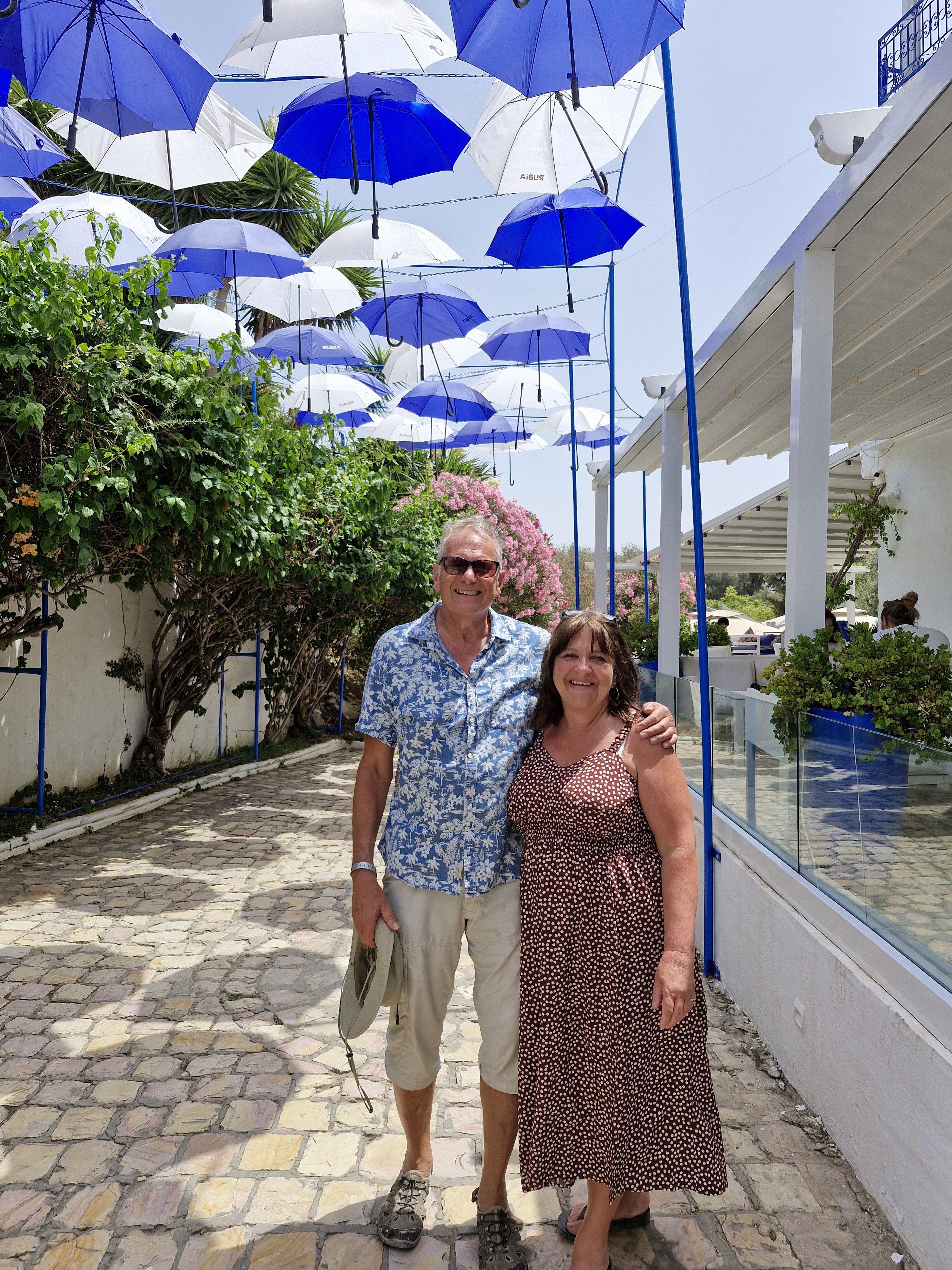
If you enjoy our stories and guides, please consider buying us a coffee. We’re a couple of pensioners who believe that joy is often found in the simple things – a good cup of coffee, a beautiful view, a shared laugh, and a new place to explore. Your support helps us continue our travels, discover hidden gems, and share honest stories about finding connection, adventure, and happiness at every stage of life. Every coffee is appreciated, and every contribution helps keep Grumpy Old Guides on the road.



Leave a Reply